Showing posts with label genealogy. Show all posts

Thursday, December 18, 2014


#5 - More Family Stories and Pictures - of an Early Colonial Minister, a Kidnapped Bagpiper, a Reluctant Teacher, and a Cook Book-Writing West Point Cadet


Glidewell Kin: 

Rev. Ezekiel Rogers, the First Minister of Rowley, Massachusetts

Tombstone, Rev Ezekiel Rogers

Reverend Ezekiel Rogers comes from a distinguished line of English ministers. Most notable of these was his grandfather, John Rogers, a follower of William Tyndale and a martyr for his Protestant faith.

Ezekiel was born to Rev Richard and Barbara Rogers on 5 Feb 1588 in the village of Wethersfield, Essex County, England.  We do not know where he obtained his schooling, but it is documented that he led the congregation of St Peter's Church in Rowley, Yorkshire from about 1619 until emigrating to New England in 1638.

St Peter's Church, Rowley, Yorkshire, England
The first mention of Rogers in official writings in his new home appeared in October of that year, as Ezekiel "sought for himself and for his people, the liberty of partaking of the Lord's Supper." That document further revealed that he and his flock had broken off with the Church of England because of its corruptions. Rogers confessed there was much he admired in that Church including a sound doctrine, but stated five main objections: 
  • First, their national church (preferring a separation of church and state),
  • Second, their hierarchy, which he considered wholly anti-christian. 
  • Third, their dead service,
  • Fourth, the compelling of all to partake of the seals,
  • Fifth, the abuse of excommunications. 

Tombstone closeup

Reverend Rogers appears to have acquired a great deal of wealth before his death in 1660. His will cataloged houses, barns, lands, and pastures as well as numerous fine quality household goods. Even after dividing his goods among all of his children from several marriages, there was plenty left over to share with his church and with that new Harvard College down at Cambridge.

photo from FindaGrave.com, courtesy of Bob Spafford
In 1994, the people of Rowley, Massachusetts, gave the above stain glass window to St Peter's Church in Rowley, Yorkshire. Known as the "Ezekiel Rogers Window," it depicts Rev. Rogers, the ship upon which the immigrants fled England, and the peoples and church buildings of the two congregations.

[How are the Glidewells related to this Rogers family? The chart below takes you from Ezekiel Rogers to Edith Glidewell. Click on image to see larger.]

Much of the information in this article was obtained from "The History of Rowley" by Thomas Gage. Published in 1840, electronic version prepared 2002. See rowley.essexcountyma.net/settlers.html 


Hamar Kin:

John Peacock's Unplanned Trip to America

Notes for JOHN  PEACOCK,  JR.from "A History of the Peacock Family" compiled by George F. Peacock:

"All the Peacocks of New Jersey, so far as is known, trace their descent from John Peacock, born in Scotland, on the 10th day of August, 1698. Tradition says that he lived on "the borders," as the tract of country along the boundaries of England and Scotland was called, with his uncle who was a musician on the "bagpipes", the national instrument of music.
'As he and his uncle were one day in a town on the water they came across some sailors in a tavern, and while playing for their amusement John was persuaded by them, after some hesitation on his part, to go on board their vessel in the evening to entertain them with his music. He told them "they would like to take away such fellows as he was" but they gave him assurance which quieted his suspicions.


'While on board he went to sleep, whether from being drugged or not is not known, and remained so until the next day. When he woke, he found the vessel was under way for America.
'Stealing children, or "kidnapping" as it was called, to send them to the "plantations" in America where they were sold to the planters, was a common practice that day as we read in histories of the time, and encouraged, by the captains and owners of the vessels who derived profit from this slave trade.
'When the vessel arrived in this country he was sold by the captain to one John Gosling, a justice of the peace, who lived at what is now known as Oliphant's Mills [New Jersey], about one mile south of the present village of Medford. Squire Gosling possessed a large extent of land around the neighborhood, where it appears he carried on the milling business." 
And that - my dear readers - is how John Peacock arrived in America. His would become a new world success story. He learned the milling business well and while enduring the setbacks common to most settlers of this new land, became a wealthy man. He married Elizabeth Prickett of the Prickett's Fort family written about in an earlier post.  Tradition says that she worked at sawing logs as well as he, and due to their industry and his proverbial Scots' frugality, acquired considerable property.  

John died of dropsy (usually a reference to congestive heart failure) June 5th, 1759 and was buried in the Episcopal church burial yard at Mount Holly, New Jersey.


[How are the Thompsons and Hamars related to the Peacock family? The chart below takes you from John Peacock to my paternal grandmother, Celia Hamar Thompson. Click on image to see larger.]


* * *

Hackney & Holmes Kin:

Why My Mother Became a Teacher

We should begin by saying that Betty Hackney was a brat, a precocious child. She confessed that to me more than once in her later years. She was also bright, and her father exerted his influence as a school board member to get her enrolled a year early in the one-room school down the road, thus allowing her mother a little peace and quiet in the home.

Betty Hackney (third from left) at Union School
With that year's head start, she graduated from high school in nearby Wellington at the age of 16, and headed off to college at Pittsburg State Teachers College. She chose biology as a major, and at the end of the first semester (perhaps the first full year), she announced to her father that she wanted to become a nurse.

"NICE GIRLS DON'T BECOME NURSES." 

Her father had spoken, and that was that. Once again, her Papa exerted his influence, and within a few days she had received an offer of a teaching position at a remote, one-room rural school in Sumner County where she lived with the family of the school's superintendent. The nearest "town" was eight miles away - Geuda Springs, which you may or may not find on a current map.

 
Betty at Floral Vale School, her first teaching assignment
Betty did manage to return to college at Pittsburg where she received her teaching degree with a major in biology. Unfortunately, she was not qualified to coach football, so there were no openings for her as biology teacher. Finally, she found a position as librarian at Sedan (Kansas) High School. It was at Sedan that she met Burl Thompson, a hard-working butcher at Ackarman's Grocery and Hardware Store, and catcher on the town's baseball team. The rest, as they say, is history...  

* * *


Cadet Thomas Jefferson Holmes, Jr., Only person in the family tree known to have graduated from one of the US Military Academies. Born 1902 in Chicago, he graduated from West Point in 1924, and died 1993 in Baton Rouge, Louisiana. He was the nephew of John Frank Holmes (my great-grandfather).

Upon graduating from the Point, Thomas married Louisiana socialite Lucie Barbour and entered the military. Within a few years he resigned his commission, received a master's degree in mining engineering at Colorado School of Mines and joined his father-in-law's international minerals and crude oil business. Within a couple of years, Tom and Lucie returned to Lucie's childhood at Oaklawn Manor in Franklin Parish, Louisiana, to help in the managing of the vast estate - Oaklawn Manor, a Greek Revival plantation home on 100 acres of land. Web searches have led me to believe it was recently in use as a bed and breakfast, but apparently with little success. Maybe some of our Louisiana kin know more about its present state.

Oaklawn Manor


Tom rejoined the army in 1941, and given the rank of captain. In In August 1943, he received an overseas assignment as Assistant Chief of Engineering at the 23rd Depot Repair Squadron, at Blackpool, England. Discharged at the rank of major, he returned to New York City to do consulting work.

Not contented with city life, he returned to Oaklawn Manor, upon which he devoted vast energies to preserving the historical home, and was responsible for its current listing on the National Register of Historic Places. In their later years, Tom and Lucie moved to nearby town of Franklin. While there, Tom was to write and illustrate "The Bayou Cookbook," a financial success which later sold to a publisher.

The book cover shown here was downloaded from Amazon.com. When I first saw this item on Amazon, no author credit was listed, so I contacted them with the information I had. Apparently they agreed with me that this is the book done by our cousin, and have added his name to the page and site. See: www.amazon.com/Bayou-Cookbook

Prior to his death, Thomas Jefferson Holmes made many television appearances to promote his cook book, and was also in demand as a lecturer at state universities, speaking on the topic of Louisiana tourism.


* * *

from the Photo Archives...


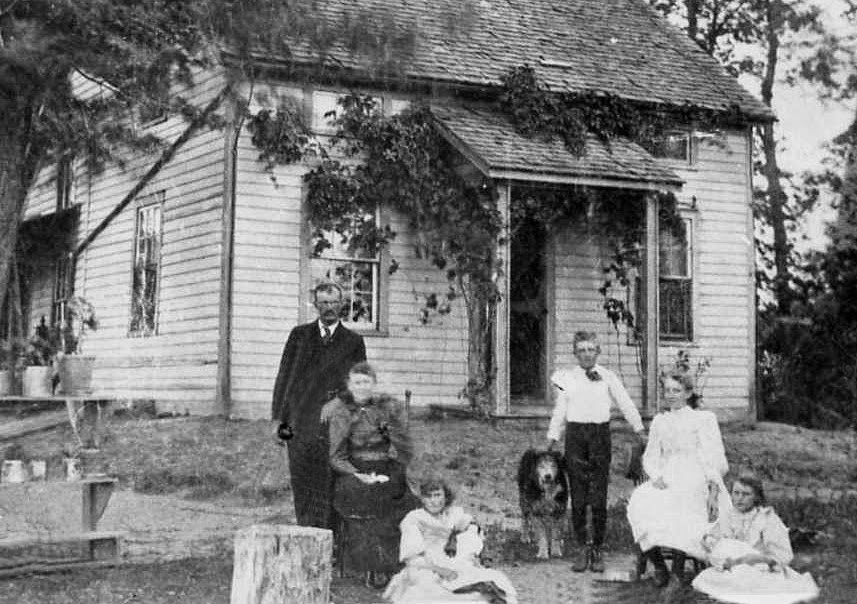
The photo I will be using in the top banner of the blog post is of the John Frank Holmes family at their home in Aledo, Illinois - about  1895 per my estimate. John Frank (dark suit) is standing behind Sarah Canum Holmes. Glen (Will) is the boy holding the dog, and next to him is the oldest daughter, Stella. The girls holding dolls in front are (I believe) Anna (left) and Maude (my grandmother - right). Cecil was born a couple of years later.

* * *

Several people have inquired about the program(s) I utilize in my family tree. I use Family Tree Maker 2014 on my PC and laptop. Online, I use Ancestry.com, World Deluxe version. The online and offline programs can be synchronized, allowing me to keep both up to date. 
I am always willing to answer questions you might have about the family tree(s) and / or research.


Saturday, November 15, 2014


Frank's Family Findings


#3 - ROAD TRIP!

A Journey into Family History


It has been seven years now since your Family Findings blogger retired from the work force.  He had quite a number of trips in mind at the time, and is grateful for the opportunity to check several of those destinations off of the bucket list, notably three memorable trips to Europe.

Due to a number of circumstances, some of the stateside trips are still undone. This fall, however, Nancy and I did undertake a road trip to visit some places I have wanted to see for years - important landmarks in our family history. Our destinations were in Ohio and West Virginia.
  
"Thanks to the Interstate Highway System, it is now possible to travel from coast to coast without seeing anything." ~Charles Kuralt~

Arriving in southern Illinois and with Kuralt's wisdom in mind, we forsook that interstate system, and followed a number of highways collectively known as the Ohio River Scenic Byway. Through Illinois and Indiana we followed in reverse the route taken by thousands of early settlers on their way to the vast spaces in the west. It was a beautiful drive, hilly and wooded, occasionally punctuated by old river towns and picturesque farms and farmlands. 

The Ohio River at Elizabethtown, Illinois


National Museum of the United States Air Force

We then swung to the north toward our first destination - the National Museum of the United States Air Force at Wright-Patterson Air Force Base near Dayton, Ohio.  

 
The main reason for visiting this museum was to see the only Martin B-26g Marauder to survive post-war demolition (and crashes). It was in the Martin Marauder that my father, Burl Thompson, flew (more than 80?) missions during World War II, mostly over occupied France and Belgium. When first introduced, that aircraft was considered unreliable, even dangerous, but Martin Aircraft continued to modify and improve it as the war progressed.


Tech Sgt Burl Thompson (fourth from left) and crew of the TABASCO, Martin B26 Marauder, somewhere in England (possibly Chipping Ongar)


The aircraft on display is painted with the colors of the 387th Bomb Group of the 9th US Air Force. This is the same group in which my father flew. These squadrons of medium bombers were charged with the task of interrupting the flow of supplies to Nazi troops on the front lines - bombing bridges, roads, railroad yards, factories, etc. 


In the Memorial Park adjacent to the museum, we found this monument to the 9th Air Force and those who flew the B-26. The 387th was among the groups memorialized.  

* * *

After an excellent German dinner in Columbus, Ohio, with nephew Bryce Kline and his lovely fiancé Jennifer, we set sail for the mountains of West Virginia - homeland to many of our Thompson / Hamar ancestors, most notably the Pricketts, Jolliffes, Springers, and Morgans.

[If you are trying to keep score, or figure out who's who: My grandmother Thompson was Celia Hamar; and her mother was Jennie Jolliffe. On this branch of the family tree, there are numerous Hamars, Jolliffes, Pricketts, Springers, and Morgans, and numerous incidences of the families inter-marrying. That's what happens with large families on the frontier. The children did not go off to college to find a mate. It seemed there were always a few potential marriage partners at the homestead down the river or the other side of the hill.]

Prickett's Fort - a faithful re-creation


Prickett's Fort

Deep in the West Virginia mountains near the confluence of Prickett's Creek and the Monongahela River sits a rustic wooden stockade - known by the earliest settlers as Prickett's Fort. What we see today, within the grounds of Prickett's Fort State Park, is a faithful re-creation of the fort as well as can be determined by writings of the period and from drawings of other similar stockades. Much more than a static display, Prickett's Fort is a living history museum, with year-round, costumed interpreters on hand to tell of the hardships and joys of frontier life.

It has been reported that Jacob Prickett was operating a trading post near the mouth of Prickett's Creek as early as 1759, dealing with the Algonquin, Iroquois, or Appalachaina peoples (includes Delaware, Shawnee, Seneca, Mohawk, etc.).  We know with more certainty that our Prickett ancestors moved from nearby Fayette County, Pennsylvania, to this rugged land on the frontier, a dangerous undertaking, in 1772. Two years later, Captain Zackquill* Morgan (for whom Morgantown, West Virginia, was named) formed a militia unit for protective purposes, and it was decided to build a fort on Jacob Prickett's land. It is believed the fort was completed by July of that year.

[Jacob Prickett is my 7th great uncle. He served as a spy for the Virginia Militia while still quite young, and later fought with George Washington in Bradock's 1758 campaign against the Indians of the Monongahela River region; Zackquill Morgan my 6th great uncle.]

Zackquill Morgan
Unlike forts with a standing military unit, this structure was meant to be a secure place for settlers to gather in times of danger, a practice known as "forting up."  As many as 80 families might crowd into  the small cabins lining the inside walls of the stockade, waiting for the danger to subside, be that days or weeks - an unpleasant ordeal, but tolerable compared to the alternative.


Other structures within the walls include such necessities as a meeting room, store rooms, and a gun smith.


Also on the grounds are a blacksmith shop, a visitor's center and museum, and Job Prickett's house shown here, built in 1859. Job was a grandson of Captain Jacob Prickett.


Prickett's Fort Cemetery:

The early settlers, mostly family members, lay at rest in this serene setting within walking distance of the visitor's center.

One prominent marker indicates the burial site (shown below) of the previously mentioned Col. Zackquill Morgan. Historians believe that Zackquill and his brother were the second settlers in what is now Monongalia County, in about 1755 or 1756. He served in the Virginia forces in the French and Indian War, later becoming a heroic leader in the Revolutionary War. He commanded about six hundred men of the Virginia Minute Men and was with General Horatio Gates at the Battle of Saratoga, New York (October 1777). [The family connection - Colonel Morgan was married to Drusilla Springer, daughter of  Dennis Springer, Sr. and Ann Prickett.]


In many places, modern tombstones have been added where the original grave markers have disappeared or been rendered unreadable. The stone shown below commemorates Charity Taylor Prickett, her husband Josiah, and Josiah's brother Isaiah who was killed Indians as he was cutting wood for the stockade. The inscription notes that Charity was the first white woman to cross the Allegheny Mountains; however, many local historians believe she was instead the first European female born west of the Alleghenies. My research shows that Charity married my 4th great-grandfather William Jolliffe after the death of Josiah. Sometimes the lines on a pedigree chart can make a few twists and turns!


The original marker below survives only in pieces at the burial site of Jacob Prickett II.  The Daughters of the American Revolution have added a commemorative plaque which will mark the spot for many years to come.


Should you find yourself traveling in the vicinity of Morgantown or Fairmont, West Virginia, I urge you to take the time to visit Prickett's Fort State Park, and to pay the admission fee to visit the fort itself.  It's an excellent place to bring history to life, for children and adults alike. It's located a couple of miles from Interstate 79, and the short drive to the site winds along Prickett's Creek (shown below).


* Zackquill is found spelled in numerous ways in historical records. The spelling I have chosen is infrequently used, but is how his name appears in baptismal records. 

* * *
  

Adams County, Ohio

Adams County is located in the southern most part of the state along the Ohio River, a short distance from Limestone, Kentucky (now known as Maysville) - a major river town and staging port during the era of westward expansion. Much of Adams County's rolling woodlands has been cleared for farming, and since the 1970s a growing number of Amish have purchased land in the county. 


Adams County has been home to a large number of our ancestors. Some stayed a short while before moving on to the west, but many more stayed for generations. There are numerous descendants of those early settlers still living in the area. When I think of Adams County, the Treber and Holmes names immediately come to mind, but research has revealed others - Chapman, Crawford, Springer, Fertig from my maternal tree, Jolliffe from my paternal tree, Stains, Minard, and Pope from wife Nancy's tree, and Rowells from our daughters' in-laws. That's for starters. 

The Old Treber Inn


Many years ago, before my interest in family history developed, I inherited this 1900-1910 era post card of the Old Treber Inn at West Union, Ohio. I heard stories of the inn from the aunts and uncles who were the keepers of family lore, and decided I must see that house for myself some day. Six decades later....

Old Treber Inn, October, 2014

In 1795,  my 4th great-grandfather John Treber uprooted his family from their home near the mouth of Peters Creek in Allegheny County, Pennsylvania. Following the Monongahela and Ohio Rivers,  surviving encounters with hostile native tribes along the way, they found their way to Adams County, Ohio. The following year, he homesteaded on a piece of land along Zane's Trace, the principal overland trail from Wheeling (then Virginia, now West Virginia) to Limestone (now Maysville), Kentucky. By 1797 he had finished construction of the home shown here.

John and Mary's new home become an inn. Known as Traveler's Rest at the time, it was a popular stopping point for travelers - some of them prominent  historical figures - en route to or from the nation's capital. Son Jacob and his wife Jane Thoroman ("Mother Treber") took over the inn and the farm. Several stories have been passed along to us, including that featured in the previous Family Findings #2 - Jacob Treber and the New Madrid Earthquake.  Look for more stories about the Trebers in the future.

The Treber Inn remained in the Treber and related Sproull families until the 1990s when it was willed to the Siningers, long-time West Adams people who had a close connection to the "Doctors Sproull" - two spinster sisters, one an M.D., the other a Ph.D., topics of a future story, I think. The house today is unoccupied, and we did not get an opportunity to view the interior. 

The exterior of the Treber Inn appears to be in fair condition at this time, but I confess that I am truly concerned about the future of this historic structure. It is listed on the National Register of Historic Places, but that status could be jeopardized if the site is not cared for and allowed to fall into a serious state of disrepair. Let's hope that doesn't happen.  

The Treber Cemetery

This family cemetery, located a couple of hundred yards from the inn, is but one of four cemeteries in the immediate area in which we can visit the burial sites of our ancestors. Because of its location and historical interest, it is the only one we chose to visit. Being there was special.

Modern stone identifies burial spot of John Treber, builder of Treber Inn


Jacob Treber, son of John, fought in War of 1812
 
Jane Thoroman "Mother Treber," famous coffee and biscuits

The John Holmes House 

Driving into the town of West Union, I pointed out a house to Nancy that I was certain to be the home of John and Elizabeth (Treber) Holmes, my 2nd great-grandparents. That was verified during a visit to the genealogical society library and museum, so we made it a point to stop there on our way out of town in order to take some photos.


In 1850 John and Elizabeth Holmes purchased a steam-powered sawmill adjacent to the Old Chillicothe Pike, now Highway 41. In 1852 they completed the construction of this home about fifty yards or so from the mill.  This is how the home looks today. 

We parked our car across the highway, then noted there was someone working in the front yard. I approached her and asked her if she might be familiar with the history of this house. She smiled at that and answered that she was. Upon learning that I was a Holmes descendant, she was delighted, saying they had never met a Holmes family member in the 42 years they had lived in the home, and often wondered what became of the family.  We were treated to a brief tour of the home and an interesting time of conversation. We were shown a small tintype photo which they had found tucked away in the basement. They were certain it was John Holmes, as was I. Below is my photograph of the photograph.


The Holmes families were staunch abolitionists, and undertook great risks for that cause. From 1852 to 1863, this home was used to hide runaway slaves on the Underground Railroad. There was at one time a hidden trap door from the kitchen into the cellar where the runaways would hide until it was safe to proceed to the next stop on the journey to freedom. From the kitchen, you can still see a house on the next hill which had belonged to Black Joe Logan, another well-known station on the Underground Railroad.  It is believed the Holmes house was designed in such a way that the two stations could signal each other.  In 1868, John and Elizabeth moved west, to Aledo in Mercer County, Illinois. Below is another picture of John Holmes. I believe this was photocopied from a book on the history of Aledo County, Illinois.


Nancy and I have the contact information for the current owners, a most engaging couple with an interest in history. If you visit West Union, we would be glad to get you in touch with them. They mentioned to us that they might even be able to help us get in to see the Old Treber Inn (just up the pike a few miles). Too bad we were getting ready to leave.

* * *

Visiting Adams County - Recommendations

Lodging: Even though it was 20 miles from West Union, we chose the John T Wilson Homestead B&B at Tranquility (website link below). Built in the 1840s by the county's richest and most influential early citizen, this house also served as a station on the Underground Railroad. After seeing the "before" photos, we were amazed at the restoration work done on this house.


Pre-historic** Site: Serpent Mound State Park - The largest serpent effigy in the world, Serpent Mound is a "1,348-foot (411 m)-long, three-foot-high prehistoric effigy mound on a plateau of the Serpent Mound crater along Ohio Brush Creek in Adams County, Ohio." Researchers have established a date of about 1070 AD for its creation by indigenous peoples. 


**Pre-historic: I must confess that I am completely baffled by that term. Think about it. 

Want to learn more? Here are some links to

SITES OF INTEREST:

Ohio River Scenic Byway (Illinois): www.ohioriverscenicbyway.net/  
Ohio River Scenic Byway (Indiana):  http://ohioriverbyway.com/
Ohio River Scenic Byway (Ohio): OhioByways/Pages/OhioRiverScenic
National Museum of the US Air Force: www.nationalmuseum.af.mil
Prickett's Fort: www.prickettsfort.org/
Adams County, Ohio Visitor Info: www.adamscountytravel.org/  
Zane's Trace (Wikipedia article): wikipedia.org/wiki/Zane%27s_Trace
John T Wilson Homestead: www.johntwilsonhomestead.com
Serpent Mound: www.ohiohistory.org/....serpent-mound
Family Tree* on Ancestry.com: http://trees.ancestry.com/tree/40792877/family?cfpid=19536761355&selnode=1

*Privacy notice - Living persons on this family tree are NOT viewable by the general public; only those who have received an invitation by me, and identified as eligible, can view living persons

Future stories --


In upcoming posts we will answer such questions as...
  • How are the Glidewells related to George Washington? (Yes, that George Washington)
  • Which Hackney ancestor was personal friends with Annie Oakley and Buffalo Bill, and had her own wild west show?
  •  Did we have any relatives at the first Thanksgiving at the Towne of Plymouth?  And, were any of our kin on the Mayflower?
  • Which Thompson ancestor stood at the side of  England's Charles I as he was executed by beheading?
  • Is it Treber or Traber? And why the two spellings of the ancestral name?
  • What does DNA testing say about our ethnicity? (mine, specifically)