Tuesday, October 21, 2014

#2 October 2014

Frank's Family Findings

#2 - Jacob Treber and the 

New Madrid Earthquake


Hackney - Holmes

Much has been written about Jacob Treber, the Trebers and the families into which they married. Fortunately, those writings have included the telling of many tales about life on the frontier, which at that time was the wilds of the Northwest Territories. Before relating that story, I should tell you who Jacob Treber is (or was). Jacob was born in 1779 in Lancaster County, Pennsylvania, but lived most of his life in Adams County, Ohio, dying there in 1875 at the age of 95. 

How are we related? Jacob and his wife Jane Thoroman "Mother Treber" (my 3rd great-grandparents)
Jacob Treber
bore twelve children, including a daughter, Elizabeth Treber. Elizabeth married John  Holmes (my 2nd great-grandparents), and they had a son, John Frank Holmes. After the family moved to Aledo, Illinois, John Frank married Sarah "Sally" Canum (my great-grandparents). Later in life and tired of the long cold winters, they moved to Sumner County, Kansas, taking their 17-year old daughter Maude Elizabeth with them. Maude taught in the one room school near their home until marrying Frank Silas Hackney, the son of the school board president and a close neighbor, in 1908. My mother, Betty, was the third of their five children.

The following is taken from The Treber Family – found in  A History of Adams County, Ohio, 1900, Evans and Stivers 

"In 18ll, Mr. Treber, with George Sample, made a trip to New Orleans on a flat-boat loaded with produce for that market. On their way, they, with others bound on a like voyage, tied their boats at New Madrid, Mo. At this time occurred the terrible earthquake at that place, a short description of which is here given in Mrs. (Jane Thoroman) Treber's own language: 
A typical flat-boat of the time
 'This first shock took place while the boat was lying at the shore, in company with several others. At this period there was danger apprehended from the Southern Indians, it being soon after the battle of Tippecanoe, and for safety several boats kept in company for mutual defense in case of attack. In the middle of the night there was a terrible shock and a jamming of the boats so that the crew were all awakened and hurried on deck with their weapons of defense in their hands thinking the Indians were rushing on board. The ducks, geese, swans and various other aquatic birds, whose numberless flocks were quietly resting in the eddies of the river, were thrown into the greatest tumult, and with loud screams expressed their alarm and terror. The noise and commotion was soon hushed, and nothing could be discovered to excite apprehension, so that the boatmen concluded that the shock was occasioned by the falling in of a large mass of the bank near them. As soon as it was light enough to distinguish objects the crew were all up making ready to depart.
'Directly a loud roaring and hissing was heard, like the escape of steam from a boiler, accompanied by the most violent agitation of the shore and tremendous boiling up of the waters of the Mississippi in hugh (sic) swells, rolling the waters below back on the descending stream and tossing the boats about so violently, that the men with difficulty could keep on their feet. The sand-bars and points of islands gave way, swallowed up in the tremendous bosom of the river, carrying down with them the cottonwood trees, cracking and crashing, tossing their arms to and fro, as it sensible of their danger, while the disappeared beneath the flood. The water of the river which the day before was tolerably clear, being rather low, was now changed to a reddish hue and became thick with mud thrown up from its bottom, while the surface, lashed violently by the agitation of the earth beneath, was covered with foam, which gathering in masses the size of a barrel, floated along on the trembling surface. The earth along the shore opened in wide fissures, and, closing again, threw the water, sand and mud in huge jets higher than the tops of the trees.
'The atmosphere was filled with thick vapors or gas, to which the light imparted a purple tinge, altogether different in appearance from the autumnal hues of the Indian summer of that of smoke. From the temporary check to the current, by the heaving up of the bottom, the sinking of the sand-bar and bank into the bed of the river, it rose in a few minutes five or six feet; and as if impatient of the restraint, again rushing forward with the redoubled impetuosity, hurried along the boats now set loose by the horror-stricken boatmen, as in less danger on the water than at the shore, where the falling banks threatened at every moment to destroy them, or carry them down in the vortex of the sinking masses.'
They reached New Orleans in safety, and after disposing of the boat and cargo they returned home on foot*, going by the way of Lake Ponchartrain, Mussel Shoals, Nashville, and Limestone.**" 

*  According to Google Maps, such a walk would cover 826 miles, and in today's conditions (paved roads, sidewalks, bridges, etc.) take 273 hours to complete.  If one could walk for ten hours a day, that would mean a journey of almost a month.
**Limestone, on the banks of the Ohio River in Kentucky, is now known as Maysville.
 

Glidewell - Hendricks 

DG Hendricks and his work horses, Beaver County, Oklahoma Territory

Davidson Gardner Hendricks (1857-1943) is the great-grandfather of my wife, Nancy and her siblings Fred and Marie. D.G. and Hattie were the parents of Etta May (often seen incorrectly as Mae). Etta May married Frank Glidewell. From that union was born Nancy's mother, Edith Pearl Glidewell Staker and her siblings Opal, Mary, and Kenneth (who died in childhood).

At Hendricks' passing in 1943, Beaver County, Oklahoma's weekly newspaper mourned the death of one of the county's earliest settlers, and the last of the Hendricks family who came to what was known as "No Man's Land" in 1906. That was in the panhandle of Oklahoma Territory, four years prior to statehood. DG was remembered as a man "of quiet, unassuming nature, but his acquaintance was large and he had many friends over the county."

Born July 28, 1857 in Marion County, Indiana, on a farm near Indianapolis, DG moved with his family to Livingston County in north-central Missouri. It is unknown exactly when that move occurred, but we know from federal census records that the Hendricks family was living there by 1870. Prior to and "during the Civil War, Grand River Township suffered greatly from pillaging and thieving by bushwhackers.(1)" Was DG witness to those historical events? We don't know.


Davidson Gardner and Hattie Foltz were wed on March 6, 1890 in a ceremony at the Union Hotel, Chillicothe, Missouri. They took up farming near Hale, Missouri, where Hattie had grown up. Five children were born there: Etta May (grandmother to Fred F, Nancy, and Marie), Wiley Oren, Harry James, Hannah Pearl, and Earl Davidson.  All would grow to adulthood.

In February of 1906, "Gard," as he was sometimes known, traveled to the panhandle of Oklahoma Territory to file a claim on 160 acres of land in Beaver County. Earlene Hendricks Schaefer, granddaughter of D.G. and Hattie, and daughter of Earl Davidson Hendricks, has done an excellent job of telling the story of the Hendricks homesteading experience. Rather than relating that story in an abbreviated version now, it will be presented as a featured story in the near future.

(1) "A History of Livingston County, Missouri" Published by The Livingston County Centennial Committee, http://www.livingstoncountylibrary.org/History/County/1937/1937grandriver.htm


Road Trip!

View of  the re-created fort at Prickett's Fort State Park, West Virginia
Nancy and I recently devoted a week to visit some landmarks pertaining to my family history - Prickett's Fort in West Virginia, the Old Treber Inn and Treber family cemetery as well as the John Holmes home in West Union, Ohio, and the National Museum of the US Air Force near Dayton. It was an exciting time for me - and we saw some beautiful country, as well. My next blog will take you to some of those locations. 


Monday, September 22, 2014

#1 - A Beginning


Frank's Family Findings

#1 - A Beginning


I have long wished to do a better job of sharing with family members some of the
fascinating discoveries made in the course of my family history research.
As  with any type of historical research, there is a great deal of minutiae involved - 
birth, marriage, and death dates, census listings of residency, wills probated, cemetery records, etc. Ultimately, however, those findings tell a life story, and better yet, lead to further discoveries of interesting, some times exciting tales and an occasional photo that tells a story in itself.

Perhaps you have watched those slick, carefully constructed television shows where celebrities "find" a distant ancestor - sometimes heroic, sometimes tragic. The producers do not bore us with tedious details of the endless but necessary hours of background research done, and I won't either.  The results of my research are on my site at ancestry.com, if you are inclined to check them out.

My goal for these blogs is to highlight the numerous stories of exceptional interest or of historical significance, and to share some of those marvelous old photos when available.

My research has been broad-based, effectively amounting to five family trees. Rather than writing five different blogs, I will combine them into one, with headings for each so you can skip over material relating to the other families, if you wish.
  • My paternal tree (Thompson and Hamar)
  • My maternal tree (Hackney and Holmes)
  • Nancy's paternal tree (Staker and Morris)
  • Nancy's maternal tree (Glidewell and Hendricks)
  • The Rowell Tree, and associated Miller and McCready lines (both daughters married into the Rowell family; I have done far less with these lines, but still have some interesting finds)
The tricky part may be keeping straight for you these different family lines. How are you related to this guy?  I may have to try different approaches to that, and will rely on your feedback if there is confusion.

Thompson-Hamar

Visiting Cumbria/Westmorland - the Ancestral Homeland of the Thompsons

In the early spring of 2013, Nancy and I made a trip to the United Kingdom. One of our goals was to visit the England's beautiful Lake District, and specifically the village of Askham. It was there that my 3rd great-grandparents, John Thompson (1757-1842) and Sarah Bowman (1770-1846)  were married and buried at St. Peter's Church, Church of England. Their son Bowman (1811-1865), eighth of nine children and the youngest male, would immigrate to Illinois in 1830, marry Elizabeth Cannon, and become my 2nd great-grandfather. 

Ashness Farm B&B, set amongst the fells
Our lodging for five days and nights was at Ashness Farm B&B, a charming 500 year old farmhouse on a 750 acre working farm outside Keswick, about an hour from Askham. From there we made road trips into the surrounding countryside, awed by the beauty of the fells (Cumbrian for these mountains) and the waters.

We planned our visit to Askham on a Sunday morning so we could attend services at St. Peter's, and having missed our exit on a roundabout, arrived a few minutes late. The church was close to full, but smiling parishioners gladly moved over to make room for strangers. The bishop from Carlisle was on hand today, as were members from a neighboring church.  The singing of familiar old hymns (to them, anyway) was hearty  and strong, while a sweet little old lady did her best to keep up on a rickety piano that may have been older than its player.

The bishop delivers a message of hope.
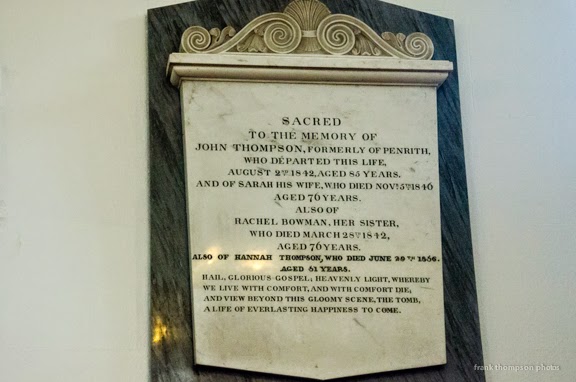
 The plaque seen on the upper right hand corner of the photo above honors the faith and service of my 3x great grandparents. An online contact had sent me a photo of it many years ago, but this was finally my chance to see it in person. See it close-up, below, and click on the image to see it larger:


I should point out that the current St Peter's Church was built in the early 1800s, after the marriage of John and Sarah, but before the death of each. Due to the size and location of this memorial, it might be a good guess they were involved in the building of the present church. Anybody volunteer to go the England to research that?


After the service, tea and biscuits (cookies) were served and there was a time of fellowship in which we had the opportunity to chat with a number of welcoming persons. They were delighted to learn of my connection to the John and Sarah Thompson honored on the wall, and informed us there were still numerous Thompsons and Bowmans in the area. It was a pity that we were due at our lodgings near Loch Lomond, Scotland on Monday evening, as it would have been interesting to follow up on that. In the photo above, I am cheesing it up with the Bishop of Carlisle, a pleasant fellow and interesting conversationalist who was eager to learn about the worship styles at the church where we worship.


 We hung around as folks were leaving in order to get some photos of the church and the graveyard. There were lots of Thompson and Bowman grave markers, but we never did find John and Sarah.

We headed off to the local pub for Sunday roast - an English tradition. Perhaps Askhams' locals eat at home or head off to nearby Penrith to eat at McDonalds, as we didn't have to hurry to get to the restaurant before the Baptists let out.


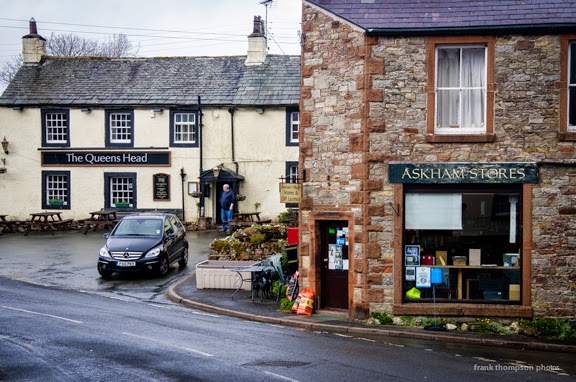
The Queen's Head Inn and Pub has been around for a long time - 300 plus years, I think, but can't find information to support that. If the food is always as good as that served to us at Sunday noon, it should be around for a long while yet. Nancy had beef roast, I had venison, both served with the traditional veggies and Yorkshire Pudding. Shown below is the venison roast.


Prior to leaving the Queens Head, we fell into a conversation with another of the patrons. At one point I expressed my surprise that anyone one should purposefully leave such a beautiful setting to strike off for the unknown wilderness of the American west. His reminded me that if my ancestor was the youngest male in the litter, there was no land, no livestock, no apprenticeship, no money, no inheritance of any kind. That was it - Bowman Thompson was the youngest boy, so striking off for America was the best choice he had.

With that questioned answered, we set out to look around Askham. Below are a few images of the village - quaint and charming are overused terms when describing such places, but appropriate nonetheless.


Due to the length of my introduction and Thompson - Hamar posting, the remaining family stories will be kept short this time:

Hackney - Holmes

The Hackney family has left us with a treasure trove of stories, some passed along orally, much in unpublished writings, and even some which has been uncovered in history books.

No Hackney has been more written about than William Patrick Hackney (1842-1926). William was the brother of OJ Hackney (my great-grandfather on my mother's side). Whether all the accounts are true is still a matter of conjecture. We know that he was wounded in the War of Rebellion (Civil War), a frontier lawyer, politician, and an early advocate for a strengthened merchant marine. (Strange, but true for a Kansas legislator)

Relating one of the more intriguing, but unproven anecdotes: William Patrick Hackney once told a
gathered crowd that he was born Patrick William Hackney, but his friend Abraham Lincoln had advised him that William P was a better name for one going into the practice of law, so the name was changed.  We do know for a fact that he was well-acquainted with the Great Emancipator, and that his father Jacob and Mr. Lincoln were on a first-name basis rare in those days - Jake and Abe. As to the name change? Your blogger has no answer for that at present.

You can be sure that you will read more about this character in upcoming posts!

Staker - Morris

The Stakers and Morrises are Nancy's paternal line. Some of the related names in this tree are: Brinker, Brücks, Kuhlmann, Lee, and Minard.

Below is a photo of Maria "Mary" Katherine Brinker Staker, great-grandmother to my wife Nancy.


Mary was born in March of 1855 in Warren County, Missouri, an area favored by German immigrants such as her father, Johannis. On the first of May, 1873, she married Johan Friedrick Kuhlman Staker. For awhile, they lived in St. Louis, where John, as he was now known, worked as a clerk in a dry goods store. Longing for land of his own, John Staker rushed off to join the Oklahoma Territory Land Rush in 1893, running the race in his covered wagon. He settled on land near the present site of Cherokee, Oklahoma, in Alfalfa County. Mary and their ten children would soon join him at their new home, and one more son would be born there in Oklahoma Territory.

Nancy's father, Fred C Staker, writing in his memoirs in 1988, recalled trips to Cherokee every March to celebrate his grandmother's birthday. Although she had learned to speak English quite well, Mary had never learned to read it, so subscribed to one of the German language newspapers common on the frontier.

Glidewell - Hendricks

These are the family lines of Nancy's mother, Edith Glidewell Staker. Some of the names found on this tree: Glidewell, Pope, Williams, Dick, and Hendricks, Foltz, Lightfoot, Lukens.

When I first saw the name Lightfoot, I thought it was a Native American name which would be challenging to research. Much to my surprise, however, I found the Lightfoots to be an old English family. Daniel Lightfoot was the first to emigrate to America, and here, folks, is his story:

Daniel Lightfoot was convicted of theft in London and sentenced to transportation to the Virginia colonies in 1732. The theft was considered a major theft because it involved items taking a multitude of items used by others in their everyday work and trade. He had an accomplice that was sentenced to death which seems very severe but I suspect that these two individuals must have had a lengthy history of violations for one to be sentenced to death and the other to be kicked out of the county. [courtesy of Brian L. Lightfoot].- (Source: Roy Ruppert, York County, Pennsylvania)
Yes, we have have a few stinkers and scoundrels swinging around in our family tree. Everybody does!


Rowell - Miller - McCready, etc

These are the family lines associated with my sons-in-law, who are cousins as well as brothers-in-law to each other. It's an Arkansas thing.

The Rowell line has been traced back to Valentine Rowell, born 1565 in Atherstone, Warwickshire, England. His first son with wife Elizabeth was Thomas "Deacon" Rowell (an actual deacon?). Thomas was the first Rowell to come to America, arriving in Massachusetts in 1638, at a time when those nasty Puritans still ruled the colony with iron fists and iron-clad laws. [More about the real lives of the Puritans in a future blog.] Valentine and Elizabeth Hampton Rowell also had twins, a boy named Francis, and a girl named Frances in 1608. How confusing would that be? (The girl died the following year.)


---------------------------------------------------------------------------------------------------------------------------


Your input and suggestions are always welcome.

Frank Thompson, 23 September, 2014